A Hanok in the Rain: The Best Weather You Can Book
Rain on clay tiles is the hanok's house concert — and Seoul's monsoon season is secretly the best time to stay in one. The acoustics of a tiled roof, how the architecture handles serious water, and what we added when the eaves alone weren't enough.
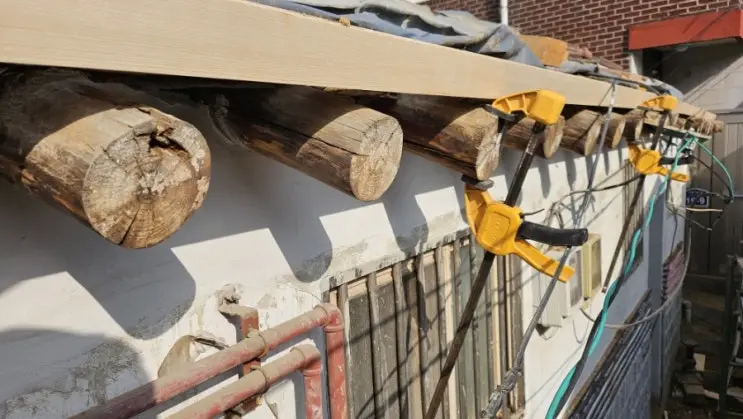
There’s a sound we spent four months of construction never once enjoying, because during renovation, rain was the enemy — tarp-rigging, forecast-checking, a genuine ceiling collapse after water found old plaster. Then the house was finished, the first real summer rain arrived, and we finally sat on the maru and listened to what we’d rebuilt:
Rain on a hanok is a performance. And almost nobody books for it, which is a travel-planning error this article exists to correct.
The acoustics of clay and tile
Rain on sheet metal is a snare drum; on flat concrete, silence with drips. On a hanok roof it’s something else entirely, and the reason is the roof’s anatomy: curved tiles over a thick bed of earth. The tiles’ channels break each drop’s impact into patter across a thousand small curves; the clay mass beneath absorbs the frequencies a hard deck would reflect. What reaches the room below is a soft, deep drumming — rounded, regular, near-white-noise — that Koreans have written poetry about for centuries and that modern guests describe with the technical term “the best sleep I’ve had in years.”
The eaves add the second instrument: water gathering along the tile channels and dropping in strings from the eave edge onto the courtyard — a beaded curtain of drips you watch from the dry maru, a meter away.
Architecture that expects the monsoon
Korea’s jangma — the summer monsoon weeks — is the stress test hanok evolved for:
- Deep eaves (extended by the buyeon rafter tier we rebuilt) throw water far from the earthen walls and keep a dry outdoor corridor around the whole house. You can circle the building in a downpour untouched.
- The tile-over-clay roof sheds in layers — surface water down the channels, incidental moisture buffered by the earth bed and released after.
- The raised maru keeps its timber above splash and damp, ventilated from below.
- The courtyard drains — ours re-engineered with the stone-coated fall and the flower bed’s full drainage stack — so rain leaves as spectacle, not as pond.
And the honest addendum from operation: eaves can’t veto wind. Our first monsoon drove rain sideways onto the toenmaru anyway, so we added the traditional system’s modern accessory — a rain gutter along the eave edge, in tile-matched charcoal so the roofline concedes nothing (₩1.1M, half the competing quote, 3.5 hours of specialist work). Five hundred years of design plus one good aluminum channel: the complete system.
The rainy-day program
What we now tell guests when the forecast turns “bad”:
Morning: coffee on the maru’s edge, under the eaves, watching the drip-curtain — the hanok’s version of oceanfront. Midday: Gyeongdong Market runs covered and rain-indifferent; market food was made for this weather (the Korean conviction that rain demands jeon — savory pancakes — and makgeolli is, we can confirm, correct). Afternoon: the brick bath with the window cracked, rain sound included at no charge. Evening: floor bedding on the warm ondol, changho open a hand’s width, the roof performing overhead.
Sunny days make better photographs. Rainy days make better stays — the house turns inward, the sounds switch on, and the whole architecture demonstrates what it was built knowing. Book the monsoon. Bring a book.
Our adversarial era with rain: tarp-rigging in #16, the ceiling collapse in #22, and peace declared via gutter in #81.
Questions we actually get
Is a hanok stay good in rainy season?
We'd argue it's the best season. The deep eaves keep the maru dry and usable, so you sit outdoors IN the rain without being rained on — and the sound of rain on tile-over-clay is famously beautiful, a soft drumming no modern roof reproduces. Jangma (Korea's summer monsoon, roughly late June–July) books quieter and stays lovelier.
Do hanok leak in heavy rain?
A maintained roof handles monsoons — that's what the interlocked tiles, clay bed, and steep fall are for. The system's real gap is wind-driven rain reaching under the eaves, which is why many hanok (ours now included) add a discreet gutter at the eave line. During renovation, an exposed roof in rain is the true emergency.
What should I do at a hanok on a rainy day?
Embrace the program the house wrote: coffee on the maru under the eaves, the bath with the window cracked, floor-lounging on the warm ondol with the changho open a hand's width for the sound. Gyeongdong Market near us is covered — rainy-day shopping works fine.