Twelve Rules From 128 Days of Self-Renovation
No general contractor, no architect on retainer — two brothers and an old hanok. The transferable doctrine that survived 128 days: masking-tape law, material personalities, when to hire specialists, how to use day-labor apps, and why sequencing is money.
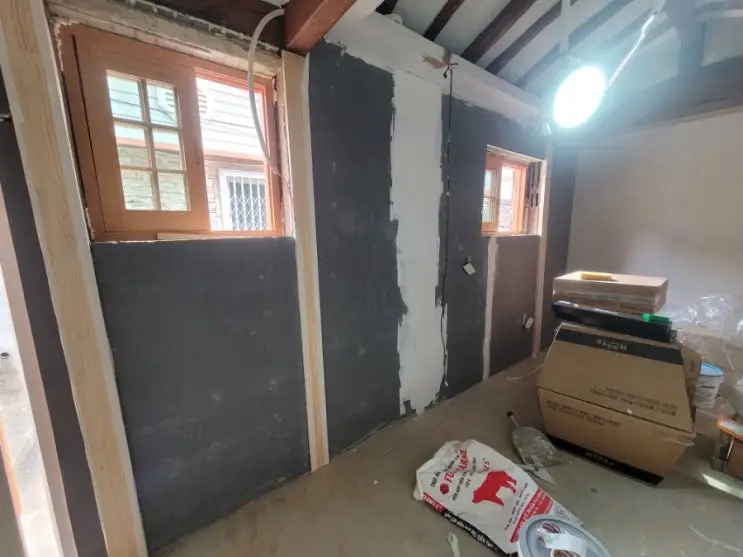
We started with a confession-worthy level of ignorance and finished with a licensed guesthouse. In between: 128 days that functioned as an unaccredited trade school where the tuition was paid in re-done work. What follows is the doctrine that survived — the rules we’d tape inside the door of any renovation, hanok or not.
1. The masking-tape law. Remove protective tape the hour the coating goes on — semi-dry at the latest. We violated this four separate times; cured cement swallows the tape edge, and a 20-minute peel becomes hours of scalpel archaeology. The single most expensive small habit on our site.
2. Materials have personalities. Obey them. X18 cement is sticky and sculptable — trowel-and-brush finishing loves it. Acrylic filler looks similar and sags off the ceiling if applied the same way; it’s a thin-coat putty, full stop. Dry-Fix is a tile adhesive that slumps as plaster. We wasted days negotiating with products instead of reading their nature — every material has one correct verb.
3. Sequencing is money, literally. We laid wood floors before finishing the walls, then spent half a day armoring the new floor against our own wall work. Trades have a correct order (dirty→clean, high→low, wet→dry); every inversion converts directly into protection labor and re-dos.
4. Finish each process completely before starting the next. The two facade rows we left un-pointed “for later” collected a month of dust in every open joint and had to be cleaned before filling. Later never comes cheaper.
5. Buy specialists for irreversible work — then study them. Plumbing, roof, structure, windows: hired. But we watched every specialist like tuition-paying students, and by week ten we were building framed walls and installing dome ceilings ourselves from observed technique. A specialist’s day fee includes a free masterclass most clients never collect.
6. The client’s job is the specialist’s workspace. Our tiler’s principle, adopted house-wide: before a pro arrives, strip the room to zero, stage materials within reach, mark every position on the walls. Our ₩800,000 whole-house re-pipe took eight hours because the rooms were readable. Site-tending is not lesser work; it’s the multiplier.
7. Write instructions on the building. Verbal briefs to carpenters across scattered work zones lose items. We wrote dimensions and quality notes directly on the walls where each task lived. A wall with instructions argues for itself all day.
8. Rent the peaks, buy the drivers, respect the humble. Grinder, drill, foam gun: buy. Second grinder for one week, thermal camera for one day: rent. And the unglamorous champions — hand trowel, steel dustpan, microfiber cloths, a baker’s piping bag for mortar joints — outperformed machinery so often it became a running joke.
9. Day-labor apps are a skill. Hiring through Karrot (₩15,000–20,000/hr) transformed our peak days — once we learned to screen ~50 applicants for reviews and relevant experience over youth, and to hand helpers a complete independent task rather than assistant duty. Keep a bench of the good ones.
10. Test on three before committing to fifty-five. Our insulation boards went up in a 3-panel pilot first — which is how we discovered we’d glued them on backwards (white bonding face out) at a cost of three panels, not a house. Every new material got a pilot patch thereafter. Cheap humility.
11. Track your own production rates. Thirty ceiling bays = 4 hours, two people. One bag of cement = ten eave bays. Once you know your speeds, a renovation stops being a hope and becomes a schedule — and solo days (we ran those too, with a written timetable) stay honest.
12. Log everything, every day. Not for the internet — though this journal became that — but because the log is the learning. Half these rules exist only because a tired person wrote down what went wrong the same evening. The renovation you document is the last one where you’re a beginner.
These rules were paid for across the whole 128-Day Log — the tape law alone in #45, #49, and #67. The financial ledger: Every Number We Wrote Down.
Questions we actually get
Can you really renovate a house yourself with no experience?
We did — with heavy caveats: we bought specialists for irreversible work (plumbing, roofing, structural carpentry, windows), watched them like students, and self-performed the repeatable 80%. The skill that matters most isn't any trade; it's sequencing, preparation, and writing down what each mistake taught you.
What's the biggest money-saver in self-renovation?
Preparation that makes professionals fast. A specialist billing by the day works at double speed in a site that's been cleared, marked, and staged for them — our whole-house re-pipe took one plumber 8 hours because the rooms were stripped and every position pre-marked. Client prep is the cheapest labor on any site.
What tools should a self-renovator rent instead of buy?
Anything needed briefly: our second angle grinder rented for ₩20,000 (vs ₩60,000 to buy), a thermal camera for ₩6,500/day. Buy the daily drivers (grinder, drill, foam gun); rent the peaks; and buy the humble hand tools everyone skips — a ₩6,000 trowel and ₩16,000 steel dustpan outworked machines during demolition.