Shoes Off: Why Korean Life Happens on the Floor
Beds are furniture; in Korea the floor itself is furniture — heated, spotless, and central to how homes work. The logic of shoes-off culture, floor dining and floor sleeping, and how to enjoy (not endure) it during a hanok stay.
Every foreign guest performs the same small ballet at our threshold: the half-step in, the freeze, the look down at their shoes, the look up at us. The rule has reached them culturally — shoes off in Korea — but not the reason. And the reason is the interesting part, because it rewires how you see every Korean interior afterward:
In Korea, the floor is not what you walk on. It’s what you live on.
The floor is furniture
Western rooms delegate living to objects — beds hold sleeping, chairs hold sitting, tables hold food, and the floor is merely the shipping lane between them. Korean domestic tradition collapsed all of those functions into the floor itself: meals at low tables with diners seated on cushions; sleep on padded bedding (yo) laid down at night and folded away at dawn; socializing cross-legged around a floor that is, thanks to ondol heating, the warmest surface in the house.
Once the floor is your dining table and your mattress, the shoes rule stops being etiquette and becomes obvious hygiene: street soles on the floor are boots on the bedsheets. The deference Koreans show floors — mopped daily, socks-only, babies parked directly on them without a blanket — is exactly the deference other cultures show tabletops. Same logic, rotated ninety degrees.
Architecture that enforces the boundary
A hanok doesn’t post a “remove shoes” sign; it builds the instruction. The step up from courtyard to maru — knee-height, unmissable — is the shoe line, a physical threshold between ground-world and floor-world. (At Doiok, a sheltered shoe cabinet stands exactly there, placed where guests transition dry-footed even in rain.) Interior floors then run at one continuous level, because when the floor is a living surface, a single step in the middle of it would be like a ridge running across your bed.
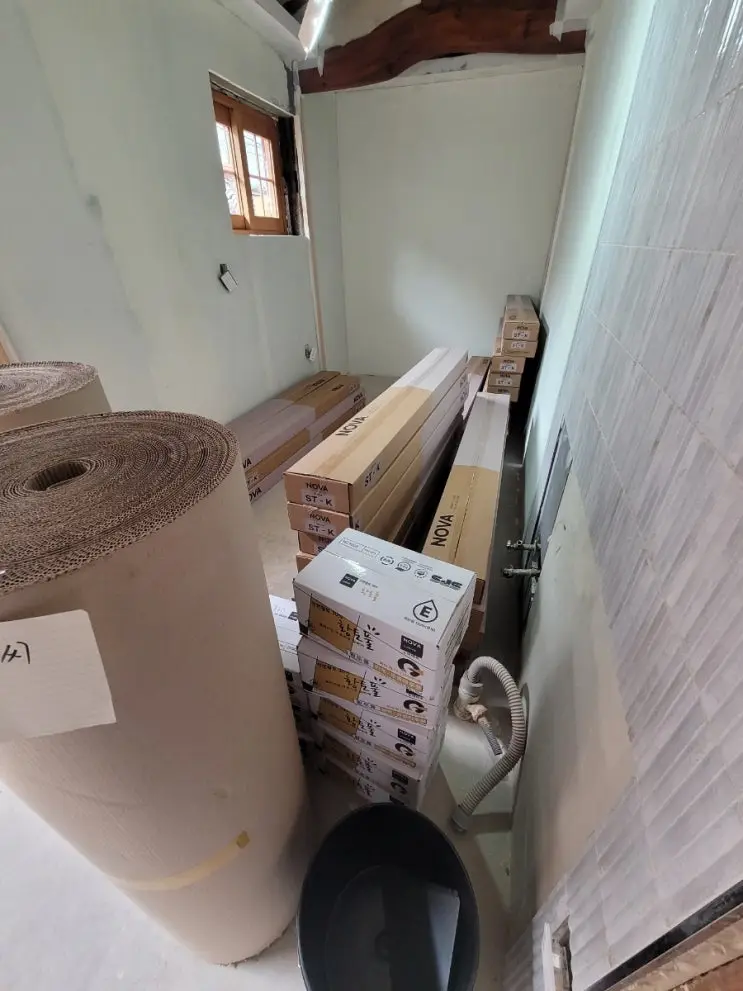
We spent real renovation capital honoring this: a self-leveling mortar pour across the whole interior (forty bags — the house had never once been flat in seventy years) and wood flooring bedded over red-clay paste so every room joins in one seamless plane. Guests feel that continuity without naming it. Their feet name it.
Living low changes the room
The practical conversions we’ve watched dozens of guests make:
- Height budgets differ. Sit on the floor and a hanok’s intimate ceiling becomes generous — the exposed rafters hang in exactly the right zone. This is why we chose a low sofa-table for dining and floor cushions elsewhere; furniture at Western height fights the architecture (a tip that came from a veteran stay operator, and proved itself instantly).
- Children need no adaptation whatsoever. Kids already live at floor level; a floor-living house is the first architecture that agrees with them. No bed edges to fall from, dining at their natural altitude. Parents relax measurably around hour two.
- Warm floor + horizontal human = involuntary nap. The national pastime. We provide both mattresses and traditional floor bedding, and our standing proposal is one night the floor way, on the ondol. Conversion rates are high.
A borrowed intimacy
Here’s what we’d tell a first-timer: shoes-off floor living is the fastest cultural immersion Korea offers, because it isn’t a performance you watch — it’s a posture you adopt. Twenty minutes in, sock-footed on a warm floor with tea at knee height, you’re not observing how Koreans live. You’re briefly doing it. The floor, it turns out, is the door.
The floor’s own construction story: the leveling pour in #42, the wood floor in #59, the low-table decision in #67. The heat beneath it all: How Ondol Works.
Questions we actually get
Why do you take shoes off in Korean homes?
Because life happens ON the floor — sitting, eating at low tables, and traditionally sleeping on bedding laid directly down. When the floor is a dining surface and a bed, street shoes on it are as unthinkable as boots on a tablecloth. Ondol heating created the arrangement; hygiene logic sustains it.
Where do I leave my shoes at a hanok?
At the boundary: hanok have a natural shoe line at the step up from courtyard to maru or room — at Doiok, a sheltered shoe cabinet by that transition. The step's height difference IS the doorway between 'outside' and 'inside'; once you're up, you're in sock world.
Is sitting and sleeping on the floor uncomfortable for Westerners?
The first hour of floor-sitting surprises the knees; most guests adapt within a day, and a warm ondol floor actively helps. For sleeping we offer both real mattresses and traditional padded floor bedding — our standing suggestion is one night on the floor. A surprising number of guests convert.