How Ondol Floor Heating Works — Explained by People Who Dug Theirs Up
Korea heats the floor, not the air — a 2,000-year-old idea that modern Korea never abandoned. We excavated, mapped, and repaired the ondol system of a 1956 hanok; here's how it actually works, from fire-and-smoke origins to today's hot-water loops.
Most heating systems fight the air. Korea decided, roughly two thousand years ago, that this was backwards: heat the floor, and let people live on it. That single inversion — warmth radiating up through your body from below rather than blowing past your face — explains half of Korean domestic culture, from shoes-off etiquette to why a Korean grandmother’s favorite spot has an exact name (araetmok, the warmest patch of floor, nearest the fire).
We got to know ondol more intimately than most: during our 128-day rebuild of a 1956 Seoul hanok, we dug through its floors, mapped its hidden pipes with a thermal camera, accidentally cut one of its hot-water lines, and repaired the failing manifold at its heart. This is ondol from underneath.
The original machine: fire, smoke, and stone
Traditional ondol is a masterpiece of getting something for free. The kitchen’s cooking fire (the agungi, a fire mouth set low at one end of the house) had to exhaust somewhere — so Korean builders routed that hot smoke horizontally, through a maze of flat stone channels (gorae) under the floor of the adjacent room, before letting it exit up a chimney at the far side.
Above the channels lay large flat stones, clay-sealed, then oiled hanji paper as flooring. The stones charged up with heat during the evening’s cooking and released it all night — thermal mass as battery. One fire: dinner and a warm bedroom. Nothing wasted but the smoke, and even that did the work on its way out.
The physics still impresses engineers: radiant heat from a large low-temperature surface is the most comfortable heat delivery humans have invented — no dry blown air, no cold ankles under a warm ceiling, no noise.
The modern translation: water instead of smoke
Twentieth-century Korea kept the principle and swapped the medium. Today’s ondol — including the system under our hanok — is hydronic: a gas boiler heats water, a distribution manifold splits it into loops, and flexible pipes snake beneath the entire floor, embedded in a mortar bed. The floor still is the heater; it’s just plumbed now.
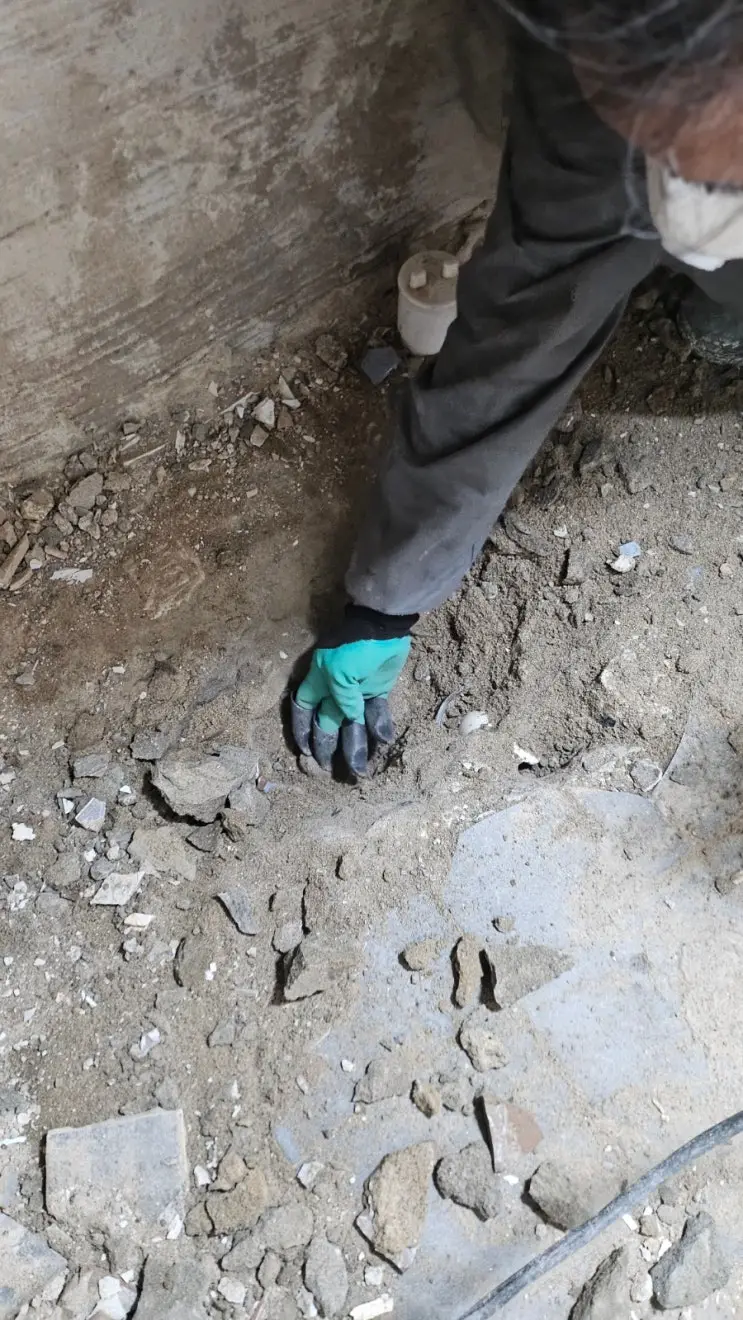
When we lifted our house’s old vinyl flooring, we met this system face to face — decades-old hot-water lines threading everywhere beneath rooms we’d assumed were just concrete. Three encounters taught us its anatomy:
- The mapping. Before any floor excavation, we rented a thermal-imaging camera (₩6,500 a day), ran the heating, and watched the loops glow through the slab — then penciled the pipe routes directly onto the floor. Every Korean renovator’s first rule: the floor is full of veins.
- The accident. We cut a hot-water line anyway, mid-excavation, along with an electrical conduit sharing its trench. (Meter and breaker were already off — the reason it’s a story and not a disaster.)
- The diagnosis. Our plumber found that one manifold port had been silently blocked for years — an entire heating loop starved without anyone knowing. He rebuilt the corroded joints in brass. If your Korean floor has one stubbornly cool room, suspect the manifold.
What it feels like to live on
Numbers don’t convey ondol; sensations do. Winter mornings, the floor greets your feet warm before the room’s air has caught up. Bedding laid directly on the floor turns the whole surface into a low, enveloping heat — the reason many Koreans still prefer a floor mattress to a raised bed in winter. Wet laundry dries overnight, flat on the floor. And there is a specific, near-narcotic pleasure Koreans call jjimjil — lying on a hot floor until your back surrenders — that entire bathhouse industries are built on.
At Doiok, the rebuilt ondol runs under new wood flooring throughout. We keep queen mattresses for guests who want height — but we’ll always suggest one night the Korean way: padded bedding, warm floor, the house’s oldest technology doing what it has done since before this hanok, or its grandmother’s grandmother, was built.
The excavation, the accident, and the manifold repair are logged in #30, #31, and #33. For the culture the warm floor created, read Shoes Off: Why Korean Life Happens on the Floor.
Questions we actually get
What does 'ondol' mean?
Ondol (온돌) means 'warm stone.' It's Korea's traditional underfloor heating: originally hot smoke from a fire channeled through stone flues beneath the floor, today hot water from a boiler circulating through pipes under it. Either way, the floor itself is the radiator.
Is ondol still used in modern Korea?
Universally. Virtually every Korean apartment, house, and hanok built today heats through the floor — radiators are essentially nonexistent in homes. The technology changed (water pipes replaced smoke flues); the principle never did.
Why do Koreans sleep on the floor?
Because the floor is the warmest place in the house. Ondol made floor-sitting and floor-sleeping not a sacrifice but the premium position — which shaped everything from Korean bedding (padded mats laid at night) to why shoes never come indoors.