Changho: The Lattice Windows That Make a Hanok Glow
Wooden lattice, mulberry paper, and light you can't get from plate glass — hanok windows are a philosophy of illumination. What changho are, how paper windows actually perform, and what we learned installing eight traditional units in one ten-hour day.
Stand inside a hanok on a bright afternoon and the light is wrong — wrong, that is, if your baseline is glass. No glare, no hard-edged sunbeams, no view demanding attention. Just an even, milky luminance filling the room from its paper-and-lattice walls, as if the daylight had been strained. Korean aesthetics has spent centuries on exactly this quality of light, and the instrument that produces it is the changho.
Windows that are also walls, doors, and furniture
The first thing to unlearn: a hanok doesn’t strictly have windows the way a brick house does — punched holes in solid walls. Much of a hanok’s perimeter is changho: wooden lattice panels, sliding or hinged, filling the structural bays between posts. Summer tradition even lifts whole door-panels up onto hooks, dissolving the boundary between room and maru entirely. The wall is negotiable; that’s the point.
The lattice (salmunui) patterns — simple grids, dense mesh, flower-and-lattice hybrids — were a status language and remain a joinery showcase: dozens of slim wooden members, half-lapped into perfect intersections, holding tension without a single fastener across a panel light enough to slide with one finger.
The paper argument
Skinned over the lattice, traditionally, is hanji — paper made from mulberry bark, and one of Korea’s quiet material masterpieces. Set aside the fragility assumption; hanji windows earned their centuries:
- They insulate meaningfully better than the single-pane glass that eventually competed with them — an air-holding fiber mat versus a cold conductive sheet.
- They breathe. Hanji passes air and moisture slowly, buffering interior humidity — a companion technology to the clay roof and mud walls doing the same job.
- They filter light into the diffuse glow above — and at night, reverse the trick: interior light turns every window into a lantern, which is why a lit hanok warms its whole street.
Ours are the modern compromise: traditional lattice frames from a hansik changho workshop, glazed rather than papered — Seoul weather, security, and guests’ expectations all voting for glass — with the lattice still doing the light-scattering work.
What installing eight of them taught us
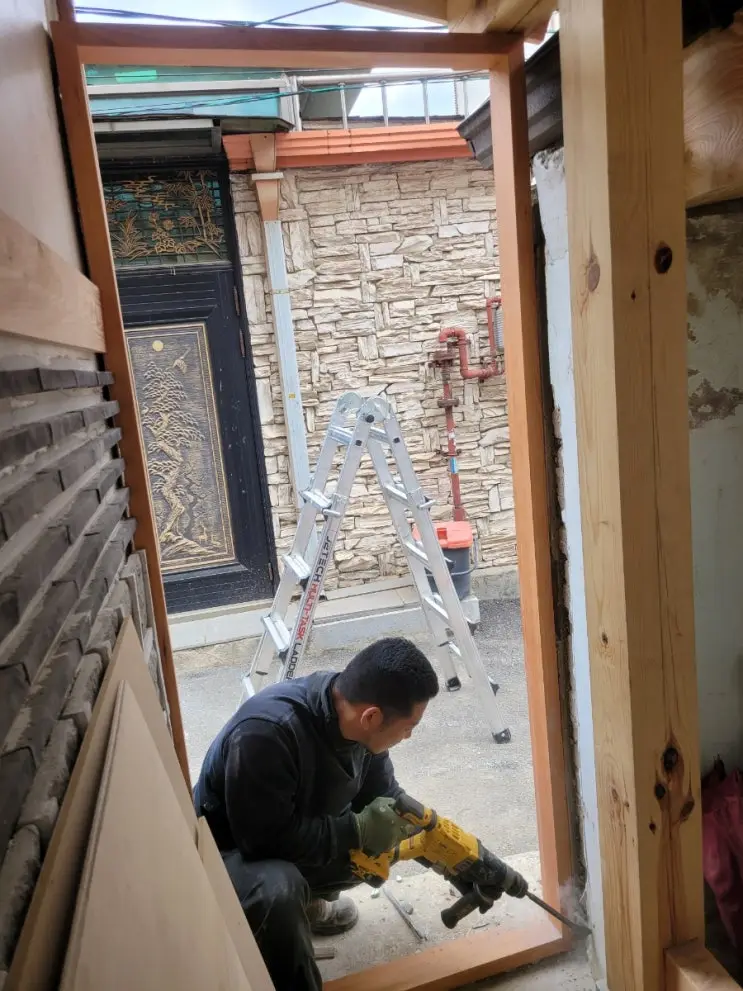
Day sixty of our rebuild was changho day: two gate doors, two annex windows, three large courtyard-facing units (the glass walls between our rooms and the madang), plus a fire door — 10 a.m. to nearly 8 p.m., and an education:
- Window installation is 80% frame installation. Plumb, level, rigid — the sash is an afterthought that hangs in minutes. All drama lives in the frame.
- Old openings negotiate. Where ordered frames disagreed with 70-year-old walls by centimeters, the wall lost — jackhammer persuasion — and final truing used wooden wedges and folded cardboard, tools Sejong’s carpenters would recognize.
- The pro tip we now evangelize: have the installer, not the salesperson, take the site measurements, against openings you’ve already cleaned up. Every millimeter of survey accuracy is an hour saved on install day.
- Frame-to-wall gaps in a hanok are inevitable, not shameful: sealed with silicone, absorbed into the finish.
We also kept the house’s original windows where they survived — reassembled and rehung in the master bedroom, rusted security grilles wire-brushed and spray-painted rather than replaced — because a few panels of genuine 1956 joinery, imperfections included, anchor everything the new workshop frames imitate.
By dusk, lattice shadows crossed the new floors, and the house had its eyes. Since the roof went on, no single day changed it more.
Changho day is logged in #52; the original windows’ rescue in #26 and #72. For the light these windows serve, see Lighting a Hanok.
Questions we actually get
Are hanok windows really made of paper?
Traditionally yes — hanji, Korea's mulberry-bark paper, pasted over a wooden lattice. Hanji is surprisingly tough, insulates better than single glass, breathes (moderating humidity), and turns direct sun into soft diffuse light. Most renovated hanok today, ours included, glaze the lattice frames with glass for weather and security, keeping the light-filtering geometry.
What does 'changho' mean?
Changho (창호) is the collective word for a hanok's windows and doors — historically a fluid category, since many hanok 'walls' are actually removable lattice panels. The lattice patterns (grid, lattice-of-lattices, flower forms) are a craft genre of their own.
Why do hanok glow at night?
Interior light passing through paper (or frosted glazing) turns every window into a soft lantern — the opposite of a dark glass rectangle. A lit hanok reads as warm from the whole street, which is why night photos of hanok villages look the way they do.