Grinding Seventy Years Off the Rafters: Why Hanok Ceilings Look Like That
The exposed dark rafters against white ceiling bays — the signature hanok interior — isn't preserved, it's excavated. We ground, masked, stained, and repaired every rafter in our house by hand. What the look costs, and why it's worth it.
Every hanok photograph is secretly a photograph of the ceiling: dark timber ribs running in rhythm, white bays between them, the whole roof’s skeleton on display like the hull of an upturned ship. Guests assume it was always like that.
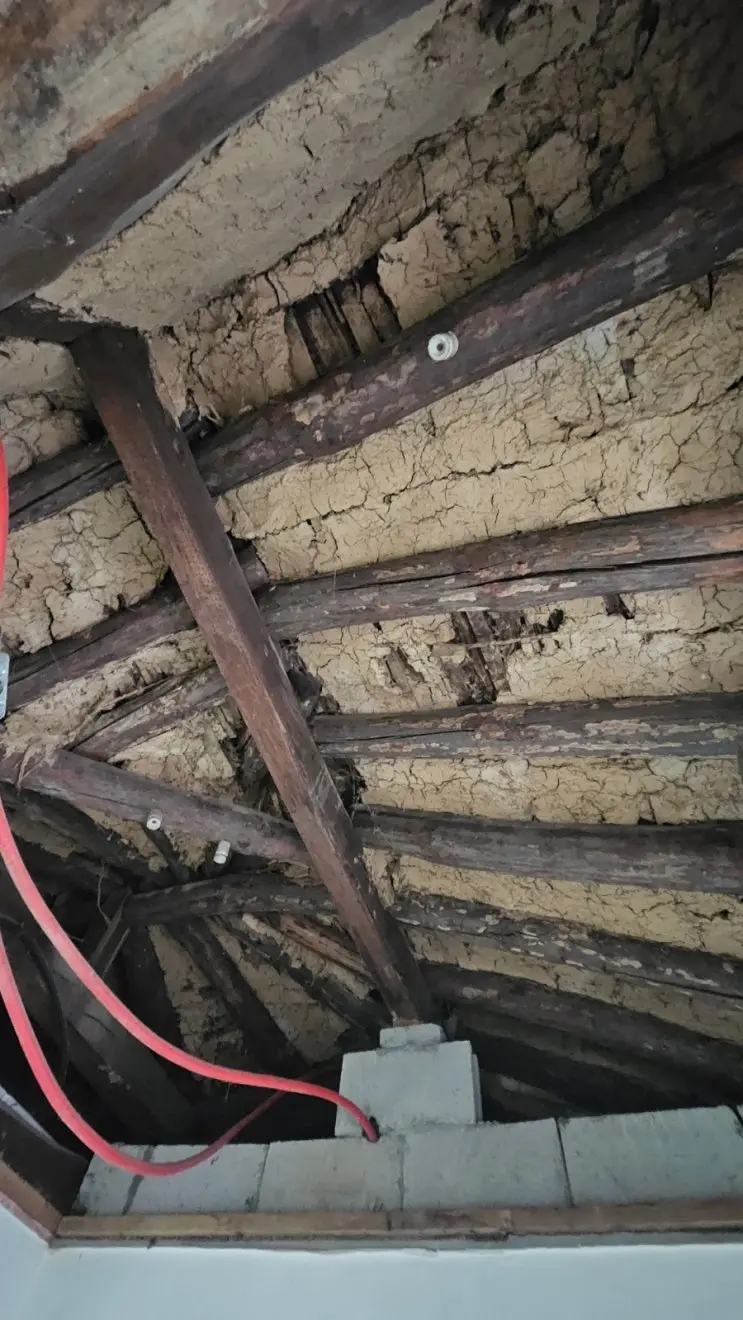
Ours looked like this instead, in February: a sagging false ceiling of boards and layered wallpaper, and above it — once we tore that down — rafters the color of old smoke, rough, stained, hidden for decades. The signature hanok interior isn’t preserved. It’s excavated. We spent more cumulative hours on our rafters than on any other single element of the house, and this is what that actually involves.
First, the reveal
Demolition day one: ceilings down, and daylight from the roof holes hit timber that hadn’t been seen since — judging by the newspapers behind the wallpaper — sometime mid-century. The revelation is structural too: with the false ceiling gone, rooms gain half a meter of perceived height under a hanok’s modest roofline, and the whole geometry of the house (beams, purlins, the great daedeulbo) becomes legible. We also knocked out the clay infill above the main beam — an un-structural wall that boxed the corridor’s ceiling — and the sightline ran suddenly the length of the house.
Then, the grinding — a season of it
Old rafters can’t just be painted; grime and raised grain would show through anything. So: angle grinders with flap discs, one rafter at a time, overhead, for weeks. The tool-knowledge we earned:
- 40-grit beats 100-grit. The finer disc flatters the grain but wears out so fast the disc-changes eat the day. Coarse and steady wins.
- Two grinders, two brothers doubled the pace for ₩20,000 — the second one rented from the hardware store, our introduction to the rent-don’t-buy rule for short-duration tools.
- A day’s honest output: just under one room’s worth of rafters. Budget accordingly, emotionally.
- Late discovery that would have saved us hours: for lightly-soiled timber, a wet microfiber cloth first — much of what we ground away would have wiped off.
The color problem
Ground rafters are raw and pale; the hanok look wants deep, aged warmth — and matching new stain to old wood turned out to be the renovation’s fussiest aesthetic decision. Our failures, so you can skip them: rose-red (far too red), light pine (ghostly against original timber). The rules that emerged: judge samples after drying (wet stain is a liar), in daylight, directly against untouched old wood. Winners: walnut-pine for the interior structure, applied after masking every adjacent surface — because the crisp line where dark rafter meets white bay is the whole aesthetic, and it’s made of masking tape and patience.
The white bays are a disguise
Between the rafters, the classic look calls for pale plaster. Ours is a modern system wearing that costume: rigid foam insulation cut to each irregular bay, cement plaster over mesh, paint. The house reads traditional; the thermal envelope reads 2026. We consider this the ideal hanok bargain — the structure honest and exposed, the physics quietly upgraded. (Full detail in the insulation deep-dive.)
Why it’s worth a season of your arms
Because the ceiling is the hanok’s argument. Flat drywall would make these rooms ordinary at any size; the rafters make even the small rooms events — you lie in bed reading the carpentry of 1956, adze marks and all. Every hour of grinding is visible forever, in the best way: not as labor, but as wood that finally looks like what it always was.
Rafter work threads the whole log: first grinding in #03, the masking doctrine in #21, staining days in #50–51, and the microfiber discovery in #79.
Questions we actually get
Why are hanok ceilings open to the rafters?
Historically, rooms were often covered by flat false ceilings; the open-rafter look (yeondeungcheonjang) belonged to grander halls. Modern hanok renovation almost always opens ceilings up — the exposed structure is the house's best feature, adds perceived height under modest rooflines, and shows the craft honestly.
What are the white sections between the rafters?
Those bays (traditionally clay-plastered) are the underside of the roof structure between each rafter. In our renovation they're insulation board finished with cement plaster and painted white — the modern envelope hiding inside the classic look. The dark-timber-on-white rhythm is the hanok interior's signature.
How do you restore old blackened rafters?
Grind, then stain. Decades of grime and oxidation come off with an angle grinder (40-grit flap discs beat 100-grit — finer discs wear out too fast), then oil stain in a tone matched to the original wood. Test colors after they DRY: wet stain lies. For mild grime, try a wet microfiber cloth before any sanding — it often suffices.