Seoul's Disappearing Hanok — and What Saving One Actually Takes
Seoul once held tens of thousands of urban hanok; a fraction survive, and most stand outside the famous preservation districts, aging without heirs. Why the ordinary hanok is vanishing, what the economics of saving one look like, and the case for staying in them.
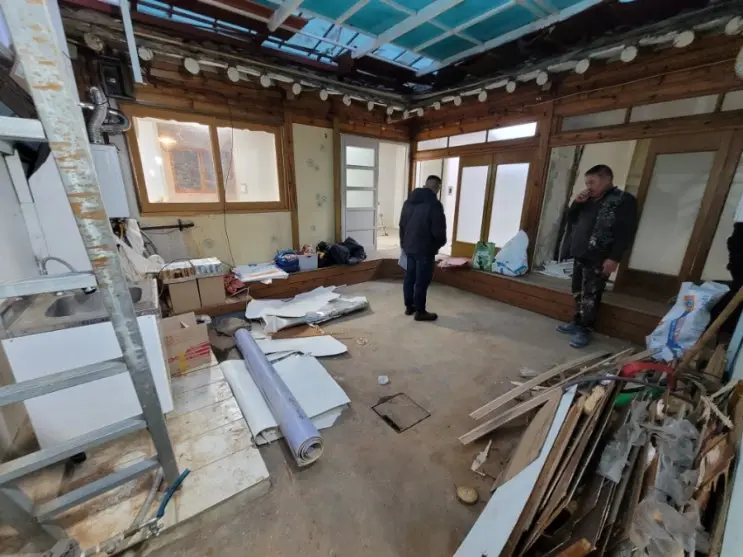
Walk our block in Jegi-dong and you can read the whole story in a hundred meters: one hanok kept proudly, its tiles straight; two more surviving under sheet-metal hats and tarps; a gap where one stood last year, now parking; and ours — which spent decades disappearing under a steel canopy until it was invisible from its own street. When we tore that canopy down, neighbors stopped to watch a hanok reappear. Several told us they’d forgotten it was one.
That block is Seoul’s hanok situation in miniature, and it’s worth understanding before the last act writes itself.
The scale of the vanishing
Mid-century Seoul was substantially a hanok city — street after street of the compact tiled courtyard houses built en masse in the 1920s–60s (ours, 1956, is a typical citizen of that wave). Then came the apartment decades. The arithmetic has been brutal ever since: from those hundreds of thousands, Seoul’s surviving urban hanok now number in the low tens of thousands by generous counts — and the protected ones, in showcase districts like Bukchon and Eunpyeong, are the minority. The rest stand in ordinary neighborhoods like ours: unlisted, unphotographed, aging on land worth more empty.
The mechanism isn’t villainy; it’s compound arithmetic. A single-story timber house occupies an apartment tower’s footprint. Its owners age; its heirs live in towers already. Repair quotes exceed the building’s paper value (we can itemize why). Each year of deferred maintenance raises the repair bill and lowers the resale case — decay is the default state, demolition the default exit. What’s lost isn’t only architecture: it’s the last physical evidence of how this city’s ordinary families actually lived.
What saving one actually involves
We can testify, receipt by receipt. Saving a neglected hanok means: demolishing its decades of survival cladding to find the frame (the bones are usually better than they look — our carpenter’s first words); re-bedding a roof by the truckload; retrofitting insulation, plumbing, wiring, and bathrooms into a structure that predates all four; and then the less-discussed half — the paperwork. Repair subsidies exist but demand architect-drawn plans (our commissioned floor plan, fine for construction, was legally worthless) and cover narrow scopes; our tile type qualified only for conversion costs. Licensed operation as a stay meant a Hanok Experience Business site inspection, then an electrical safety inspection that failed us over the fine print on two circuit breakers before passing us.
None of this is a complaint. It’s a definition: a hanok survives today only when someone assembles money, labor, obsession, and bureaucratic patience simultaneously. Institutions supply frameworks; the assembly is always personal.
The economics that keep one alive
Here’s the uncomfortable, hopeful truth we’ve come to believe: sentiment doesn’t preserve buildings; use does. A hanok survives when it earns its ground — and the stay model is one of the few honest ways an ordinary hanok can. Guests fund the maintenance that heirs wouldn’t; the licensing regime enforces standards; and every booked night converts global curiosity into re-pointed walls and treated timber. Our house now maintains itself, financially, for the first time since its builder died.
Which is why we’d gently reframe the tourist calculus: staying in a restored neighborhood hanok isn’t just an aesthetic choice over a hotel — it’s participation in the only preservation mechanism that scales. Bukchon’s protected streets show what hanok looked like. Places like Jegi-dong decide whether any unprotected ones make it — and that gets decided by bookings, block by block, house by house.
One house in, we can report: the block watched ours come back, and two neighbors have since asked how much it cost and who our carpenter was. That’s how it spreads, if it spreads. One reappearance at a time.
The reappearance in question is documented from demolition day one to the final inspection. The neighborhood making the case: Jegi-dong. The philosophy: Discomfort Is the Point.
Questions we actually get
How many hanok are left in Seoul?
Estimates vary by definition, but the trajectory doesn't: from hundreds of thousands of urban hanok at mid-century to somewhere in the low tens of thousands today, with only a minority protected in designated districts like Bukchon. The unprotected majority — ordinary neighborhood hanok like ours — declines yearly through demolition and decay.
Why are hanok being demolished?
Land economics: in redevelopment-hungry Seoul, a single-story timber house sits on land worth more as an apartment footprint. Add aging owners, heirs who don't want the maintenance, repair costs that exceed the building's market value, and regulatory grey zones — decay becomes the default and demolition the exit.
Does Seoul support hanok preservation?
Yes, with real but bounded programs: repair subsidies (with conditions — architect-drawn plans required, and specific scopes like traditional-tile conversion), designated hanok districts, and a licensing regime (Hanok Experience Business) for stays that keeps restored houses economically alive. We navigated several of these; the paperwork is its own renovation.